
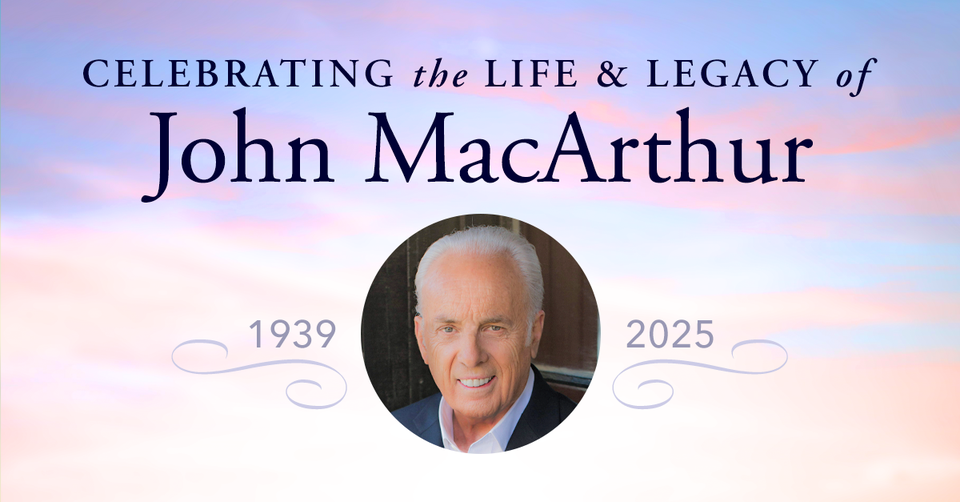
Dr. John MacArthur, a towering figure in modern Christianity, dedicated his life to proclaiming the truth of God’s Word with unwavering commitment. As the pastor-teacher of Grace Community Church, founder of Grace to You, and chancellor emeritus of The Master’s University and Seminary, his influence has touched countless lives across the globe. With a ministry spanning over five decades, Dr. MacArthur’s legacy is one of faithfulness, humility, and devotion to equipping believers with the truth of Scripture. This post reflects on his remarkable contributions through his pastoral leadership, apologetic endeavors, and academic influence, honoring a man who tirelessly served the church until his passing in July 2025.
A Faithful Shepherd: Pastoral Work at Grace Community Church
Since February 1969, Dr. John MacArthur served as the pastor-teacher of Grace Community Church In Sun Valley, California, leading the congregation for an extraordinary 56 years. His ministry was marked by a deep commitment to expository preaching, carefully unpacking the Bible verse by verse with a focus on its historical and grammatical context. Under his leadership, Grace Community Church grew from a modest congregation to a vibrant community, with its 3,500-seat auditorium filled to capacity for Sunday services. Thousands participated in fellowship groups and training programs, many led by lay leaders equipped through MacArthur’s emphasis on discipleship.
MacArthur’s pastoral heart was evident in his accessibility and care for his flock. He prioritized answering congregants’ questions, often engaging in extended Q&A sessions to address their spiritual needs. His sermons, spanning the entire New Testament over his tenure, were not only a cornerstone of Grace Community Church but also a global resource, freely available through Grace to You. His approach modeled a shepherd’s love, blending bold truth with compassion, as he sought to edify the church and lead souls to Christ.
Defending the Faith: Apologetic Contributions
Dr. MacArthur’s apologetic work was a powerful extension of his ministry, characterized by a steadfast defense of biblical truth in an age of compromise. Through his preaching, writing, and media presence, he addressed theological controversies with clarity and conviction. His commitment to the sufficiency of Scripture shone in books like The Gospel According to Jesus, The Truth War, and Strange Fire, where he confronted errors such as easy-believism, postmodernism, and charismatic excesses. These works equipped believers to discern truth and stand firm in their faith.
MacArthur’s apologetic influence extended beyond the written word. As a guest on platforms like Larry King Live and The Ben Shapiro Show, he articulated the gospel to diverse audiences, engaging culture with grace and boldness. His radio program, Grace to You, broadcast over 1,000 times daily in English and Spanish, reached millions, defending the core doctrines of Christianity—such as the deity of Christ, salvation by grace through faith, and the authority of Scripture. His legacy as an apologist is one of courage, equipping the church to uphold the gospel in a skeptical world.
Shaping Minds: Academic Leadership and Scholarship
Dr. MacArthur’s academic contributions have left an indelible mark on Christian education. As president (later chancellor emeritus) of The Master’s University since 1985 and founder of The Master’s Seminary in 1986, he championed rigorous, Christ-centered scholarship. Under his leadership, The Master’s University expanded to offer diverse undergraduate and graduate programs, including an extension campus in Israel and online degrees, making biblical education accessible worldwide. The Master’s Seminary trained hundreds of men for pastoral and missionary roles, emphasizing expository preaching and theological precision.
MacArthur’s scholarly output was prolific, with nearly 400 books and study guides, including the widely acclaimed MacArthur Study Bible, which has sold over one million copies and been translated into multiple languages. His MacArthur New Testament Commentary series provided pastors and laypeople with accessible yet profound insights into Scripture. In 2021, he contributed to the Legacy Standard Bible (LSB), an update to the NASB ’95, ensuring accuracy and fidelity to the original texts. Through these efforts, MacArthur equipped a generation of leaders to faithfully proclaim God’s Word.
A Lasting Legacy of Faithfulness
Dr. John MacArthur’s life was a testament to God’s grace, marked by an unyielding commitment to Scripture and the gospel. Despite health challenges in his later years, including heart surgeries and a battle with pneumonia in 2025, he remained steadfast, preaching as recently as November 2024 and expressing hope to return to his beloved pulpit. His personal life reflected his faith, as he shared 61 years of marriage with his wife, Patricia, and raised four children, leaving a legacy of 15 grandchildren and nine great-grandchildren.
As we reflect on Dr. MacArthur’s life, we are reminded of his own words: “You don’t retire from a calling.” His ministry, built on the foundation of God’s Word, continues to inspire and guide believers worldwide. From the pulpit of Grace Community Church to the airwaves of Grace to You, from the classrooms of The Master’s University and Seminary to the pages of his books, MacArthur’s legacy endures as a beacon of truth, humility, and devotion. Let us give thanks for this faithful servant, whose life points us to the glory of Christ and the power of His Word.
For more on Dr. MacArthur’s ministry, visit Grace to You or The Master’s University and Seminary.

 R-Rated Religion
The Consistency Policy
Rabbi Michael Glass There is a recorded discussion between the great rabbis of the mishnaic era in which different opinions were offered as to which verse of the Torah was the most fundamental. The first verse suggested was “Shemah Yisroel…”, a crucial verse which affirms our acceptance of the Almighty’s rule. The next opinion suggested the verse which announces the commandment to love one’s neighbour as one loves oneself, which is also understandably a very fundamental tenet in Jewish thought. However the final suggestion, which was declared the winner, was a verse contained within this week’s portion, the parsha of Pinchas. The victor was the verse which requires the priests in the temple to offer up one “tomid” offering every morning and another “tomid” offering every afternoon. The obvious question is how could this verse even compete with the other verses suggested let alone win the contest. What is so crucial about this mitzvah to the extent that it was decided to be the single most important verse in the whole Torah?
An answer suggested is that the all-important lesson and message hiding behind this verse can be summed up in one word- Consistency. The korbon tomid of morning and afternoon were offered up every single day irrespective of all other considerations. The secret to succeed at anything in life, in this case religious observance and spiritual growth, is consistency. Uncalculated leaps of growth are often met with consequent falls.
We need to be consistent Jews.
R’ Ezer Pine
___________________________________
___________________________________
Avodah, oath-alliance, and tohor middot form the judicial architecture of Israelite sovereignty. Torah mussar demands tohor middot not as private ethics but as judicial kavanah: the moral preparation to participate in a legal culture where interpersonal damages are adjudicated with precedent, equity, and national memory. To rebuild the Mishkan—does not to revive a sacrificial cult—but rather to restore the Sanhedrin model of lateral common-law courts, rooted in oath, guided by prophecy, and animated by the living flame of justice that defines the brit between Israel and our Tribal God.
A significant tension within contemporary Jewish thought regarding the interpretation and application of halakhah (Jewish law) in relation to ethical principles and communal obligations. The reference to the debate among the tannaim in the Midrash underscores the complexity of defining a “great principle” in Judaism, where different voices emphasize various aspects of the tradition.
The opinions of Ben Zoma, Ben Nannas, and Shimon ben Pazi reflect the multifaceted nature of Jewish law and ethics. Ben Zoma’s focus on the Shema emphasizes the importance of kre’a shma as tefillah דאורייתא, while Ben Nannas highlights interpersonal ethics through the command to love one’s neighbor; neighbor restricted to bnai brit Israel exclusively. Shimon ben Pazi’s reference to the Korban Tamid, points to the centrality of this Torah precedent as the basis of the Order of the Siddur ritual in Jewish communal life.
The emphasis on avodah as a procedural backbone highlights the importance of tohor middot in the dedications made by the Yatzir HaTov within the heart. Where a blessing requires שם ומלכות – meaning blowing a spirit from within the Yatzir Ha’Tov within the heart with a specified tohor Oral Torah Horev middah – מלכות. This oath sworn alliance serves as the continuation of the Divine Brit cut with the Avot which continuously creates from nothing the chosen Cohen people.
The concept of oath alliance Cohen duty refers to the Torah obligations to impose judicial court room lateral common law courts to hear and resolve damages disputes which divides our people continuously. The משל of korbanot teaches the נמשל of Judicial Sanhedrin common law lateral courtrooms as the k’vanna intent of building the Mishkan.
Every ברכה requires שם ומלכות not merely for halakhic formality, but because it is a miniature reenactment of Horev—a recommitment to the oath-alliance that binds Israel to its judicial destiny. The Yetzir HaTov—the moral will within—is not emotion but juridical intent (kavvanah) expressed through tohor middot, aligned with Horev’s legal categories, as embodied in מלכות. This מלכות is not monarchy in the political sense, but juridical sovereignty—the power to hear, judge, and rectify disputes among Israel through the tefillah dedication of tohor middot which define and shape how Jews behave toward other Jews. The Siddur serves as the ‘table of contents’ Order by which the Framers of both Mishna and Gemara organized the Talmud. The 3 separate opinions, rephrase the same identical idea much like a blue print offers a Front, Top, Side perspectives!
The interplay between halakhah, ethical principles, and communal obligations in Jewish thought represents a multi-dimensional interpretation of the “great principle”. Each opinion—Ben Zoma, Ben Nannas, and Shimon ben Pazi—highlights distinct yet interconnected aspects of Jewish life, emphasizing the importance of both ritual and ethical dimensions. Ben Zoma’s focus on the Shema as a foundational prayer underscores its significance as a mitzvah from the Torah (דאורייתא). This highlights the centrality of prayer in Jewish life and תולדות subservient role of the Shemone Esrei to remember the oath sworn by the Avot to continuously create from nothing the chosen Cohen people. Ben Nannas’ emphasis on loving one’s neighbor, reflects the ethical obligations that bind the Jewish community; Israel came out of Egypt to rule Canaan with righteous judicial courtroom justice which makes fair restorations of damages inflicted by Jews upon other Jews. Hence Torah mussar requires the dedication of tohor middot to bring about social behavior rooted in communal relationships and responsibilities. Shimon ben Pazi’s reference to Korban Tamid serves as a model for the Order of the Siddur as the fundamental kabbalah how the Framers organized both the Order of the T’NaCH and Talmud.
The concept of avodah as a procedural backbone emphasizes the importance of tohor middot (pure character traits) in the spiritual and ethical life of the community. The Yatzir HaTov, representing the moral will, is integral to this process, as it shapes the intentions behind actions of tefillah kre’a shma and tefillat shemone esrei – both require tefillen because both have the k’vanna to swear a Torah oath. nderstanding positions the judicial system as a vital component of Jewish identity and practice, rooted in blessings which require שם ומלכות. The pursuit of judicial courtroom justice among our people, not merely ritualistic as the statute perversion halachic codes Yad, Tur, and Aruch falsely declare. The Siddur’s role as a ‘table of contents’ for the Mishna and Gemara illustrates how the oath brit sworn by the three Avot functions as the יסוד not only of the organization of the Siddur but of the organization of the T’NaCH, Mishna, Gemara, and Midrashim as well. This organization allows for a comprehensive understanding of the relationship between law, ethics, and communal worship. The perspectives of the prophets & tannaim\amoraim serve as a blueprint for understanding the complexities of Jewish common-law, and its application in contemporary life, reinforcing the importance of both ritual and prophetic mussar dimensions in maintaining a cohesive and vibrant community.
LikeLiked by 1 person
why do you keep posting these long form comments?
LikeLike
Reactionaries prefer 10 second sound bite propaganda.
LikeLike
The perceived omissions or failures of others, such as Leo Tolstoy, Rabbi Stephen S. Wise, and Amy Katz, can be viewed as complicity or indifference in the face of injustice. The consequences of such omissions can be profound, especially during times of crisis, as they may contribute to a culture of silence or inaction regarding pressing issues like antisemitism. Leadership morally opposes antisemitism, it does not quietly ignore violent pogroms like the Oct 7th 2023 Hamas surprise attack!
Leaders especially those who make claims of moral superiority and hold positions of influence, if they actively oppose hatred and discrimination they must do it equally across the board. Calling Israeli leaders “war criminals” while quiet upon war crimes committed by others, like Hamas, makes such people antisemitic pigs.
LikeLike
Ok but I make no claims about Israeli leaders as war criminals. You are picking a fight with someone who is not fighting your fight.
LikeLiked by 1 person
Glad to hear this news.
LikeLiked by 1 person
so why are you carpetbagging my site with information that is not germane to my topics?
LikeLike
Pointing out that post Civil War Yankee Carpet-baggers ie the Federal bureaucracies totally stink and utterly suck. States Rights Washington Bites.
LikeLike
The perceived omissions or failures of others, such as Leo Tolstoy, Rabbi Stephen S. Wise, and Amy Katz, can be viewed as complicity or indifference in the face of injustice. The consequences of such omissions can be profound, especially during times of crisis, as they may contribute to a culture of silence or inaction regarding pressing issues like antisemitism. Leadership morally opposes antisemitism, it does not quietly ignore violent pogroms like the Oct 7th 2023 Hamas surprise attack!
Leaders especially those who make claims of moral superiority and hold positions of influence, if they actively oppose hatred and discrimination they must do it equally across the board. Calling Israeli leaders “war criminals” while quiet upon war crimes committed by others, like Hamas, makes such people antisemitic pigs.
LikeLike
This has very Little to do with my blog.
LikeLiked by 1 person
Throughout history, various Christian denominations have contributed to the spread of antisemitic attitudes and actions, creating a climate of hostility toward Jews. This includes theological teachings that portrayed Jews in a negative light and blamed them for the death of Jesus. The Nazi regime, though not the Vatican (the Pope looked on as the Nazis deported the Jews of Rome to death camps), maintained a close alliance with the Lutheran Church in Germany. The Nazis frequently cited Martin Luther’s racist statements about Jews. Christian churches in England and the USA failed to condemn the British White Paper of 1939, and in the United States, not a single Christian denomination opposed Roosevelt’s decision to close U.S. borders to Jewish refugees fleeing from Nazi extermination camps.
Many argue that the historical role of the Church in fostering antisemitism is of immense significance. The formal apologies, educational initiatives, and interfaith efforts made by Christianity after the Shoah seem like cheap excuses—like teats on a boar: useless and too late. Historical antisemitism within Christianity contributed to the conditions that made the Shoah possible. The Church, as an institution, bears full guilt after over 2,000 years of blood libels, ghettos, and mass expulsions of entire Jewish populations. The words of the Gospel are tragically confirmed: “By their fruits you shall know them.”
The assignment of criminal guilt, especially in connection with historical events and religious groups, is the subject of this statement. Justice requires naming guilt—and, where necessary, advocating for extreme measures like the death penalty. Throughout history, all Christian denominations have played a role in solidifying antisemitic attitudes and actions, thereby contributing to systemic discrimination and violence against Jewish communities. This includes theological doctrines that justified the kidnapping of Jewish babies through forced baptism and war-crime-level mass expulsions.
Taxation imposed by the Church without political representation constitutes a form of European enslavement of the Jewish people. Religious Christian organizations must take full responsibility for the actions of their followers and for the ideologies of racial violence they spread. The failure of many Christian churches to denounce antisemitism and to take a stand against the atrocities committed during the Shoah reflects broader complicity in these historical injustices.
The lack of accountability can perpetuate cycles of hatred and violence—and points to the need for a deeper reckoning with history. It is essential to critique and hold Christianity accountable, both theologically and institutionally. Christian theologies which promote, Love as the greatest commandment, Fire and Brimstone Heaven Hell God Satan bi-polar emotional declarations – all expressions of Av tuma emotional spirits which indoctrinate mental insanity.
Impossible to not be under the Law and then unilaterally declare which of the multitude of T’NaCH and Talmudic commandments and Halachot qualifies as the most important of all Torah common law. This narishkeit nonsense compares to the 666 mark of the beast and the Church declarations that the Christ killer Jews bear the mark of Cain. Xtianity no different than Nazism. Both promote hate propaganda in the name of Love.
LikeLike
Christianity no different than Nazism? You might be a crazy person 🤬. These are rants no coherent statements. Do you live in Israel?
LikeLike
Both Xtianity and Nazism promote Jew hatred and racism.
LikeLike
No they don’t! Christianity teaches love and understanding. You just hate Jesus, that all.
LikeLike
The Shoah … the fruits of Xtian church hatred of the Jewish people.
LikeLike
“But whoever denies me before men, I also will deny before my Father who is in heaven”.
LikeLike
The oath brit alliance that Avraham cut with HaShem, that the Spirit of the Name would forever live within the hearts of his chosen Cohen people. Goyim, never part of the chosen Cohen people, they have no brit alliance with the God of Israel.
LikeLike
That alliance was broken brother. Due to Christ, Christians – through faith in Christ — are now grafted into that alliance. The ancient Israelites were disobedient and broke all the covenants God made with His people.
LikeLike
BS. The oath that the Avot father the chosen Cohen people Chag Yom Kippur forever remembers. Your johnny come lately JeZues simply a pie in the sky myth. Clearly your first grade teacher failed to read to you the story of the Sin of the Golden Calf, remembered every Yom Tov of Rosh HaShannah.
Grade school literalist assume the Golden Calf a literal Golden Calf. LOL No different than the Genesis Creation stories literally understood that in 6 days the Universe created and the Elohim rested on the 7th day. LOL Sucks being you – tied to your literal belief in Torah metaphors! Actions have their consequences, your literalist church “believes” the literal word of God LOL what an absolute joke. Your sophomoric translations of the T’NaCH — utterly pathetic. Sucks being a moron lead by brain dead morons.
Brit does not correctly translate as “covenant”. Ooooops. The first word of the Torah בראשית/In the Beginning\ contains words within words that your moronic dumb-ass translations remain totally oblivious thereto. בראשית … ראש בית ,,, ב’ ראשית … ברית אש.
Being so completely illiterate and forced to rely upon pathetic sophomoric translations which limit the Torah to “In the Beginning”. LOL Sucks being you.
To cut a Torah “ברית/brit” requires שם ומלכות. LOL you do not know what either key term means. Your worthless sophomoric bible translators failed to discern the meaning of שם, they translated this רוח הקודש\Holy Divine Spirit/ as “lord”. If your pathetic literalist read the story of the Golden Calf, ערב רב\mixed multitude assimilated Jews who intermarried with Egyptian Goyim, made a sophomoric translation of the Name to אלהים, this Name first introduced in the story of בראשית…the 2 Creation stories ב’ ראשית – Two Beginnings. LOL The aggadic midrash story of the Creation of the Yatzir HaTov vs. the Yatzir HaRah\the opposing Inclinations found within the heart, comparable to the two opposing babies wrestling in the womb of Rivka the wife of Yitzak.
Ya see bozo if as your pathetic narrative declares: a oath brit can be broken or annulled, as if no distinction exists between swearing oaths from making a vow. The nazirite vow serves as an example. Traditionally such a vow lasts but one month/30 days. Why? What does this teach? Answer: Vows exist as tactical and temporary. Whereas Oaths breath the eternal breath of Divine life. No break a Torah oath, like as occurred in the Floods in the days of Noach; breaking oaths brings total destruction upon the Earth.
Sucks being a literalist and limiting the aggadic midrash story of Noach and the floods to a literal ark. LOL Sucks being a moronic fool. The Xtian church profaned the oath Sinai commandment not to murder throughout history. Torah commandments qualify as Torah oaths, just like as told in the story of Noach and the Ark.
3 years after the slaughter of 75% of all European Jewry, the Jewish state – dead for over 2000 years – rose up from death unto life! Now Xtianity as a dead religion waits for the 2nd coming of its silly mythical JeZeus the Son of Zeus like the myth of Hercules. HaHaHaHa the jokes on you.
LikeLike
You claim to be grafted into a brit alliance which you claim is broken. LOL Make up your mind. You have no education of the chosen Cohen people – the seed of Avraham Yitzak and Yaacov. Your substitute theology replacement nonsense seeks to transform JeZeus the imaginary myth man as the chosen Cohen people. LOL You declare that “ancient Israelites were disobedient” yet you do not know the sworn oath by which Avraham Yitzak and Yaacov sworn couter-oaths with the God of Israel.
You do not know what שם ומלכות, the basic requirement of swearing a Torah oath even means. LOL Sucks being a pathetic Goy ignoramus. Post Shoah guilt the Xtian church bears the mark of Cain. You wander to and fro as despised refugee populations. Europe no longer even Xtian anymore. LOL You rot and stink in exile waiting for the 2nd coming of your mythical silly god. You and your church have become the butt of jokes and ridicule. Sucks being you.
LikeLike
Protestant “dogmatism” redresses Catholic “dogmatism”. Both tits on a boar hog useless.
C.S. Lewis’s “The Great Divorce” – a narrative that presents a fictional journey from a gray, dreary town (representing Hell through this metaphor) to a vibrant, beautiful heaven, where the characters confront their own choices and the nature of their desires. On par with the Aslan lion metaphor which depicts the Easter resurrection from the dead story.
The “Great Divorce” theme focuses upon pride. Many of the characters in this metaphor cling to their “sins”. A guilt trip that dates back to the apostle Pauls’ “Original Sin” narishkeit. A lot of Goyim reject the NT guilt trip ideology. The entire Xtian theology of Heaven and Hell, pie in the sky religious theological speculations. The Talmud teaches a person who speculates on matters which the Human mind cannot conceive or grasp … better that such persons’ never born.
To make literal declarations like “All in hell want to be there”, simply perverting a children story as depicting actual reality – what complete and utter nonsense! The theological creed Xtian belief systems qualify as examples of the metaphor story of residents of hell who made conscious choices that reflect their fervent beliefs in some pie in the sky Nicene theology of the Trinity.
Torah has no concept of “Free Will” as Calvin solemnly declared. John Calvin’s “dogma” of Free Will emphasizes the sovereignty of some undefined god. His theology promotes the notion that this undefined Universal god has predetermined who will be saved and who will be damned. This perverse dogmatism defines the key component of Reformed Protestant theology.
However, Calvin did acknowledge the concept of human responsibility and moral choice within the framework of his Universal god’s sovereignty. Mighty White of him to grant his Universal god these powers; such as grace – essential for salvation.
Interesting – Moshe’s Torah and the Oral Torah-Talmud defines the middah of grace as the dedication – through swearing a Torah oath – of some unspecified tohor middah, as the k’vanna of the tohor midda of Grace. For example the tohor middah of mercy which learns from the commandment to obliterate every man woman and child of Canaan, or to the commandment to slaughter the youth – stubborn and rebellious son, or the commandment to make eternal war upon the assimilated mix multitude of Jews who lack fear of Elohim, known as Amalek. Commonly known today as antisemitism etc. Clearly Calvin’s Protestant dogmatism, like Catholic dogmatism, upon this foundation stands the theology espoused by C.S. Lewis likewise rejects Oral Torah common law precedents, some of which – listed above, as the means to interpret the k’vanna of both tohor middot of grace and mercy!
LikeLike
In Jewish thought by stark and absolute total contrast, faith in God not some cult of personality personal or spiritual theological belief system; Torah faith deeply intertwined with ethical prophetic mussar, and social justice. The Torah obligations absolutely require the active pursuit of judicial common law justice through the Sanhedrin courtrooms. Principles of justice and fairness in all dealings, especially in legal matters define the Torah concept of faith.
The Torah mandates stong emphasis on the appointment of just judges, expected to act with integrity and impartiality. In Deuteronomy 16:18-20, the commandment to appoint judges and officers in all cities underscores the importance of justice: “You shall not pervert justice; you shall not show partiality, and you shall not accept a bribe, for a bribe blinds the eyes of the wise and twists the words of the righteous.” This principle, echoed in the teachings of the sages, who stress that a corrupt judiciary undermines the very foundation of society and the time-oriented brit which forever and eternally creates the chosen Cohen people from nothing. Hezekiah’s actions seen as a common law precedent for Sanhedrin justices to pursue justice and righteousness, ensuring that their governance aligns with the values of the Torah through משנה תורה legislative review of all laws and decrees imposed by Government statute laws.
The presence of bribed judges and corrupt courtrooms leads to the Torah curse of societal decay and a loss of faith among the people; meaning Jews assimilate and embrace the culture and customs of foreign peoples. These aliens reject the revelation of the Torah at Sinai and Horev. When judicial common law justice collapses, it creates a disconnect between the community and HaShem; failure to do and keep tohor time oriented commandments perverts the chosen cohen nation unto just another Av tuma Goyim people. The “converted” non Cohen-people, abandoned or betrayed by leaders equally abandon their faith – the obligation to pursue judicial justice among and between Jews. The prophetic T’NaCH literature often addresses the consequences of injustice, warning that societal ills can lead to divine judgment – Torah curses – like as happened to Par’o in Egypt in the days of Moshe and Aaron. This serves as a reminder that faith most essentially defined, not as Av tumah avoda zara which demand that a Goy believe in this or that theological creed God, but rather Torah faith lives only through pursuit of judicial common law courtroom judgements that promote justice and equity among and between our conflicting peoples.
This mussar tradition, it emphasizes the cultivation of personal virtues, including integrity, honesty, and a commitment to justice among our people. Prophetic mussar encourages the active pursuit of judicial common law justice to resolve our damages disputes between our people in all generations and all times. These T’NaCH/aggadic and midrashic teachings, they most essentually stress that true loyalty to the Torah brit faith involves far more than personal religious piety, like as promoted by the Shulkan Aruch. But, for more essential, to pursue an active participation in creating a just society, where the rights of all individuals Jews honor and respect and uphold by validating the rulings of the Sanhedrin common law lateral courtrooms.
The connection between faith in HaShem and the pursuit of justice, the fundamental theme in Torah thought, which most essentially defines the Torah concept of faith. The example of King Hezekiah, as Moshiach revolves around the rebuke of the prophet Natan to the house of David following the death of the baal of Bat Sheva. The Torah curse of Civil War to plague all generations of the House of David, over his profaning the oath dedication of Moshiach in the matter of the killed husband of Bat Sheva. Loyalty to the Torah Constitution most essentially manifests itself in ethical mussar behavior which remembers the rebuke that the prophet Natan cursed the House of David, specifically in the realm of justice over the criminal death of the baal of Bat Sheva. The integrity of the judicial system, which failed to hold king David to stand trial. Later the Talmud would acquit king David of murder. However, this Talmudic opinion does not change the fact that David, and his son Shlomo failed to establish the authority of the Sanhedrin Federal court system as the definition of building the Temple on Zion.
LikeLiked by 1 person
“If we deny him, he also will deny us”.
LikeLiked by 1 person
To deny a myth carries absolutely no repercussions or consequences.
LikeLiked by 1 person
Xtianity guilty of the Shoah war crimes. By their fruits you shall know them. YOUR own silly imaginary God eternally rebukes your dead church who rots and stinks in exile waiting for the 2nd coming of your mythical Zeus son JeZeus.
LikeLike
Xtianity bears the full guilt of the Shoah. Your JeZeus died on the Cross will not atone for the Shoah crime against Humanity.
LikeLike