

Introduction
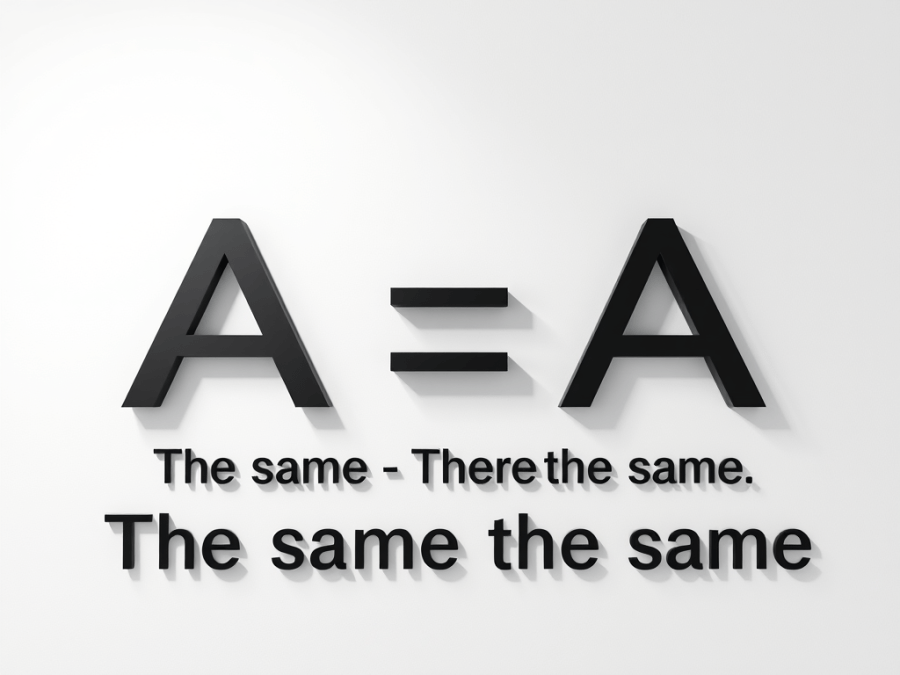
The First Law of Logic, known as the Law of Identity, states:
A is A.
In simple terms: “A thing is what it is.” If we say “a pen is a pen,” we’re recognizing its fixed identity. This seems obvious—but without this law, clear thought and communication collapse.
Why It Matters: A Research-Based Perspective
- Foundation of Reasoning
Modern logicians, like Irving Copi, affirm that “logic depends on the Law of Identity as its starting point.”[^1] - Semantic Clarity
Philosopher W. V. O. Quine notes that language becomes incoherent if terms lack consistent reference.[^2] - Avoiding Contradictions
As Aristotle observed, denying identity leads to self-contradiction: if “A is not A,” nothing can be known.[^3]
How It Works – A Simple Walk through
- Example 1:
“A red apple is a red apple.”
Means we don’t confuse an apple with, say, an orange. - Example 2:
“If John says, ‘This is green,’ when looking at a red apple, he’s mistaken.”
Because he’s denying the apple’s identity.
Without the Law of Identity, we couldn’t rely on words to carry consistent meaning. Every discussion would be a guess.
Mini-Graphic 1
Mini-Graphic 2

Red Apple 🍎 ≠ Orange 🍊
(Because each has its own identity)
Putting It Into Perspective
- Every meaningful claim relies on identity, e.g. “Truth is truth.”
- Science, law, everyday speech all assume things don’t change meaning randomly.
Tying It to Christianity
- God’s Unchanging Nature
Scripture says, “Jesus Christ is the same yesterday and today and forever” (Hebrews 13:8). The Law of Identity affirms God is who He says He is—no more, no less. - Jesus’ Claims
When Jesus said “I am the way, the truth, and the life” (John 14:6), He operated under identity. If “Jesus is truth” is false, the rest falls apart. - Defending the Faith
Using the Law of Identity lets Christians show that logic and reason support scripture. If identity breaks down, so does meaning—and with it, divine revelation would be unintelligible.
In other words:
It is perfectly logical to use logic to defend the Judeo-Christian faith, because the faith itself affirms identity (God is who He is; Jesus is who He is).
🛐 Closing Prayer
Heavenly Father,
We thank You for giving us minds capable of logic and reason.
Help us honor truth in all things—reflecting Your unchanging nature.
May our reasoning always lead us back to You,
and may we stand confident in defending our faith with both heart and mind.
In Jesus’ name, Amen.
[1]: Irving M. Copi and Carl Cohen, Introduction to Logic, 12th ed. (New York: Macmillan, 1990), 19.
[2]: W. V. O. Quine, “Two Dogmas of Empiricism,” Philosophical Review 60, no. 1 (1951): 19–20.
[3]: Aristotle, Metaphysics, Book IV, 1005b18–23.

 R-Rated Religion