

This is the second post in our Bible Study series. This week’s focus is the Book of Micah. Please share this with your local Church leadership and faith-based communities. This series is dedicated to the global Christian church and intended to edify the word of God.
The Mighty Message in the Minor Prophet: Diving into the Book of Micah
Have you ever felt like a small voice crying out against injustice? Have you witnessed the powerful exploiting the vulnerable and wondered if anyone was listening? If so, you’ll find a kindred spirit in the Old Testament prophet, Micah. His book is relatively short and nestled amongst the “Minor Prophets.” Still, its message rings with powerful resonance. It echoes across the centuries and speaks directly to the challenges of our own time.
Don’t let the label “minor” fool you. Micah was a fiery messenger from the rural heartland of Judah. He was a contemporary of Isaiah. Micah fearlessly confronted the corruption and social decay plaguing both Israel and Judah in the 8th century BCE. His words aren’t gentle whispers. They are bold pronouncements of judgment against the powerful. They are passionate pleas for justice. They also contain surprisingly tender glimpses of future hope.
In this exploration of the Book of Micah, we’ll delve into the historical context that shaped his urgent prophecies. We’ll unpack his powerful indictments against societal sins. We’ll also explore his stark warnings of impending judgment. Additionally, there are the beautiful promises of restoration. The coming Messiah shines through his pronouncements. Get ready to discover a prophet. His concerns for the marginalized are profound. His demand for ethical living is unwavering. His vision of God’s ultimate reign of peace is as relevant and challenging today as it was millennia ago. Join us as we unearth the mighty message within this often-overlooked book and discover its profound implications for our lives.
Introduction
Are messages of hope and warning still relevant to us today? If so, what does faithful living look like? These questions are addressed in the Old Testament through the various pre-exilic prophets. Micah was one such Prophet. He warned Israel and Samaria of its crimes and corruption. His warnings came just before the fall of Samaria sometime around 721 B.C. “His name is an abbreviation of Mîkāyāhû “who is like Yahweh?”[1] This meaning most likely symbolizes YHWH’s incomparability rather than Micah’s godliness.[2] Micah’s warnings of doom and messages of hope show the relevance of this book. These lessons are still significant to the modern society of today.
Warning
The book of Micah conveys admonishments toward the people of Israel and Samaria. They face impending doom if they refuse to obey YHWH’s Law of faithful living. “The major role of the pre-exilic prophets was to give a negative critique of conditions in the nation and to announce the judgment that must follow.”[3] He warns the people of that time. They should live according to the will of God. They must walk humbly with his loving kindness. They should do justice to one another.
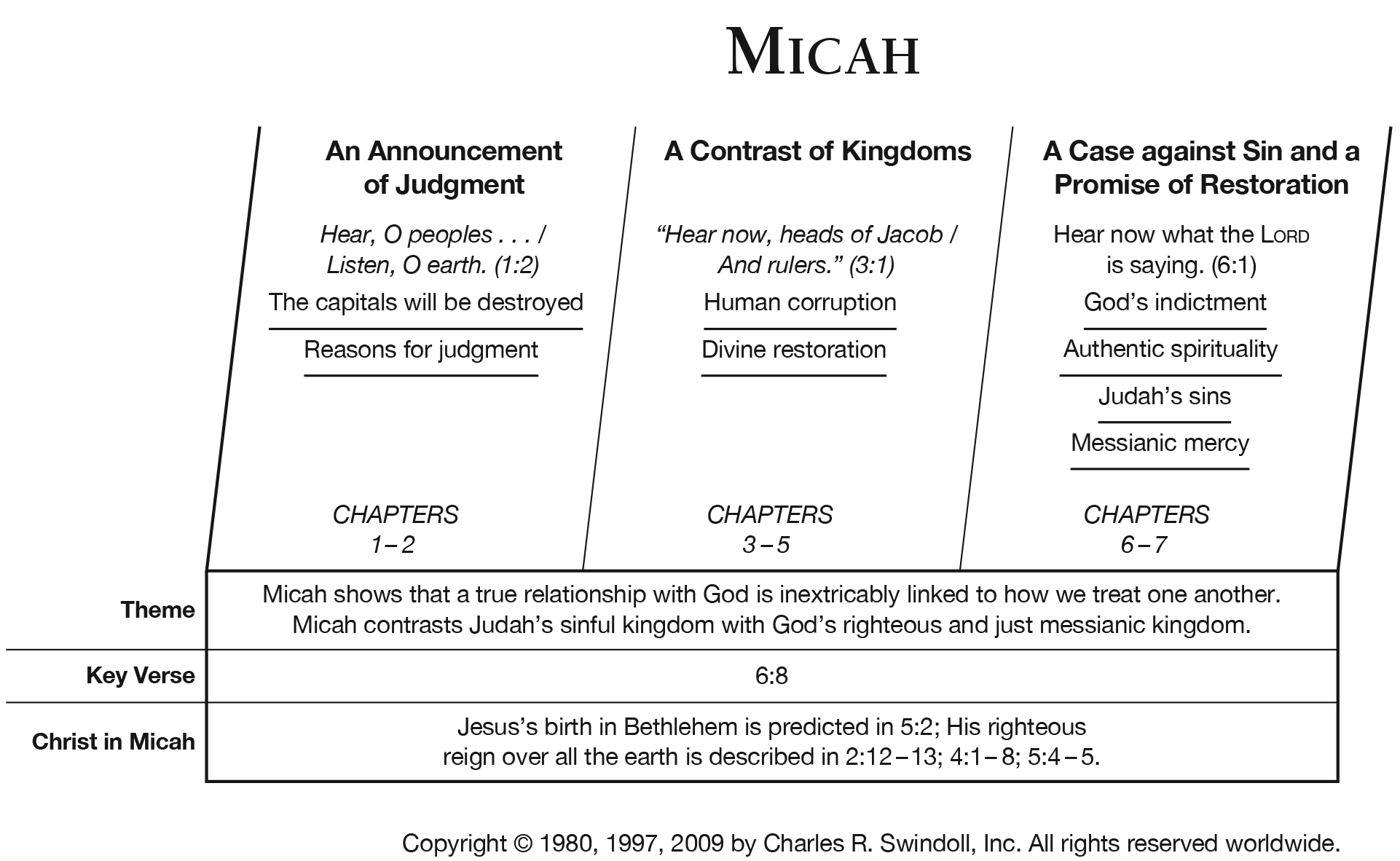
This man represented the voice of a sector harmed by the government of Israel. That government was settled in the city of Jerusalem. It was the voice of farmers marginalized by the power that was concentrated in an urban center. It is essential, then, to understand the prophet Micah in his social context and reality. Micah lived in a time in history when the powerful who were in the urban centers systematically usurped the well-being of small farmers.[5]
To properly understand the warnings of Micah, it is important to understand the context of Micah and his surroundings. We know very little about this prophet. He was most likely a farmer or landowner of the common people. He lived outside of Judah and represented those members of society currently undervalued by the Jerusalemites. “The intended readers of the book were, however, Jerusalemites.”[4] It is important to understand that Micah spoke for YHWH. He represented the downtrodden, whom he knew intimately. Esteban Voth writes:
His warnings echoed the plight of those people the powerful were neglecting.
During the reign of King Solomon, he centralized the government in Jerusalem. He also rooted out the tribalism founded by Moses. This gave way to huge bureaucracies. These bureaucracies favored the powerful and overlooked the poor and impoverished. Here is where Micah’s warnings had such sound theological doctrine. “That is, Micah wants people to note the profound reality of injustice legitimized and practiced by the powerful.”[6]
The powerful were corrupt. They still relied on spirituality and pious behavior. However, they ignored the call to live justly with all of God’s people. They had forgotten what God requires of his covenantal relationship with his people: “acts of compassionate kindness and fidelity, directed to others, and a faithful and obedient walk of life, directed towards God.”[7] Once again, God would punish those living in defiance of his covenant, as he had done before.
Hope
Micah also gives courage to those who stay faithful to YHWH. “The double note of judgment and hope gives Micah its basic structure.”[8] This book is balanced with its messages of confidence. It encourages anyone that chooses to love kindness. It also inspires those who love justice while walking humbly with their God. The book gives messages of how God will prevail. Those who are faithful to his word will endure. They will stay within his grace. The book ends on hope. It brings hope to those who are steadfast. They follow the path laid for us by the law of God to love one another. This faith of fidelity is required for God’s relationship with us as we walk along that path. Brueggeman writes; “Thus the great triad of Micah reflects the path of life—required by God of Israel and of Adam—in terms of the other on the path with us who precludes our traveling alone in arrogance or in despair.”[9]
Modern Day Relativity
Much like the powerful Jerusalemites, this world is run by the powerful oligarchy that controls the government and the banks. These oligarchs need to be checked and warned of their stronghold on the future of humanity. This is the bidding of today’s church, to hold people in power accountable for people who are trampled upon. The Church must serve the community. It should also challenge those living outside of the faith. This can be done either by academic prose or in defense of the faith.
In addition, hope and warning are still relative today as it was thousands of years ago. However, I would argue that in today’s modern religiosity, hope seems to be all the Church is selling these days. Moral admonishment has been maligned as a four-letter word and cut from most mainstream sermons. Pastors preach the hope and shy from admonishment in fear that parishioners might be offended or leave. Good biblical doctrine seems to be replaced with spirituality and feels good theology. “We live in a society which defines spirituality in many different ways. Some define spirituality as inspiring worship, as the Judeans of Micah’s day did.”[10] The political correctness environment has saturated society with such poison that it bleeds into our pulpits. This is why the prosperity gospel and your best life now messages are popular. People hunger for hope but are stridently against criticism.
A warning without hope is an empty message and lacks good biblical theology. We see this all throughout the Bible. Truth has a consequence. To live according to this truth, a faithful life is one of living set apart from the outside world. It is about walking with the Lord. God still requires fidelity and faith in him and his system of salvation. That system requires a life lived out in sacrifice, not ritual sacrifices dealt with in ancient times but sacrificial living. Faithful living is sacrificial living. It is living your life in service of others. Micah and other pre-exilic prophets espoused this same very principle.
Conclusion
The prophet Micah engages ours wants alongside the will of God. It pits the truth of our desires. It is at this crossroad that we meet our Lord in his divine judgment for our life. As believers, we have chosen a different path than the rest of humanity. Because of this choice, we are exhorted to forgo world dominance. We conform to God’s definition of justice. “After and alongside the Jewish people that same ‘choosing God’ has, in Christian confession, placed a secondary promissory people in history that, at its best, also refuses every accommodation to the ways of the world.”[11] We choose the faithful life. We set ourselves apart from the powers that exploit the needy. We serve the people of the world who seek out his glory.
Bibliography
Berlin, Adele, Marc Zvi. Brettler, Michael A. Fishbane, and Bernard M. Levinson. The Jewish Study Bible: Advance Reader’s Copy, Uncorrected Sample Pages. New York: Oxford University Press, 2004.
Brueggemann, Walter. Old Testament Theology: an Introduction. Nashville, TN: Abingdon Press, 2008.
Brueggemann, Walter. “Walk Humbly with Your God. Micah 6:8.” Journal for Preachers (2010): 14–19.
LaSor, William Sanford., David Allan. Hubbard, and Frederic William. Bush. Old Testament Survey: The Message, Form, and Background of the Old Testament. Grand Rapids, MI: Eerdmans, 1996.
Mitchell, Eric A. “Micah – The Man and His Times.” Southwestern Journal of Theology (n.d.): 57–76.
Shipp, R. Mark. “True Religion and Undefiled: Spirituality in Micah and James.” Christian Studies Journal 20 (n.d.): 23–27.
Voth, Esteban. “What Does God Expect of Us? Micah 6–7.” Review & Expositor 108, no. 2 (2011): 299–306.
Footnotes:
[1] William Sanford La Sor, David Allan Hubbard, and Frederic William Bush, Old Testament Survey: The Message, Form, and Background of the Old Testament, 2nd ed. (Grand Rapids, MI: William B. Eerdmans Publishing Company, 1996), 270–271.
[2] Eric A. Mitchell, “Micah – The Man and His Times,” Southwestern Journal of Theology (n.d.): 57-76.
[3] William Sanford La Sor, Old Testament Survey, 272.
[4] Ehud Ben Zvi, “Micah: Introduction and Annotations (מיכה),” in The Jewish Study Bible, ed. Adele Berlin and Marc Zvi Brettler (New York: Oxford University Press, 2004), 1205.
[5] Esteban Voth, “What Does God Expect of Us? Micah 6–7,” Review & Expositor 108, no. 2 (2011): 299-306.
[6] Ibid.
[7] R. Mark Shipp, “True Religion and Undefiled: Spirituality in Micah and James,” Christian Studies Journal 20 (n.d.): 23-27.
[8] William Sanford La Sor, David Allan Hubbard, and Frederic William Bush, Old Testament Survey: The Message, Form, and Background of the Old Testament, 2nd ed. (Grand Rapids, MI: William B. Eerdmans Publishing Company, 1996), 272.
[9] Walter Brueggemann, “Walk Humbly with Your God. Micah 6:8,” Journal for Preachers (2010): 14-19.
[10] R. Mark Shipp, “True Religion and Undefiled: Spirituality in Micah and James,” Christian Studies Journal 20 (n.d.): 23-27.
[11] Walter Brueggemann, Old Testament Theology: an Introduction (Nashville, TN: Abingdon Press, 2008), page not available.

 R-Rated Religion