

What book could you read over and over again?
I usually don’t respond to these prompts. WordPress posts a question every day that encourages bloggers to write about a specific theme, topic, or question. This blog is aimed at Christians. Most topics are secular. So, I typically overlook these prompts. I pay them little, if any, attention. Nevertheless, today, something caught my eye.
The question posed to us today is: What book could you read over and over again? I assume most answers will be works of fiction. They most commonly include philosophical, religious, or self-help books, among others. I want to highlight a book I read over twenty years ago while studying film at a state university. It had such a profound impact on me. It completely changed my worldview regarding race relations in America.
During my intermediate years at the University of New Orleans, I studied communications and film. I often drove home from work while listening to talk radio. This was a common habit for me at the time. Although I’m not a huge fan of Sean Hannity, it was the only interesting program available. During the broadcast, Sean was interviewing someone I had never heard of before. The incendiary words coming out of this individuals mouth sounded to me like a parody.
How this man was eviscerating black people in America was shocking. I immediately took him for a racist. After a short while, he started to make sense. The admonishments and allegations he was hurling at the black leadership of the progressive left started to resonate. The criticisms of the Democrat Party, at large, were also understandable. Thus, I was introduced to the spectacular world of Reverend Jesse Lee Peterson. He was plugging his book, Scam: How Black Leadership Exploits Black America, and my life was forever changed.
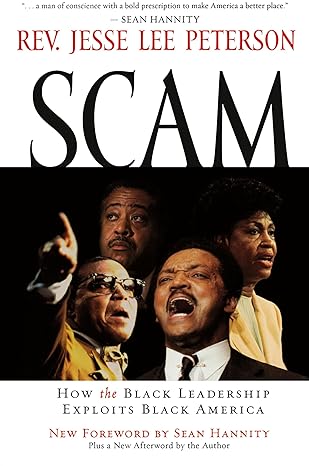
I wound up writing a ten-page book report that year on this book. My uber progressive communications Professor hated it. Over the years, I have gifted this book to more people than any other book in my arsenal. I especially gift this book to democrat black Americans who support the very leaders this book condemns. In most cases, I have found that they stop reading the book after a short while and comment that Mr. Peterson makes some good points, but they need to do the research to see if he is right.
You may agree with the thesis of the book or hate the author for writing it. Regardless, this is a “must read” piece of literature. Anyone who delves into the murky waters of race and culture should be familiar with it. The facts of the book are hard to refute, but the way in which Mr. Peterson admonishes the left for exploiting the very demographics it purports to be helping is impressive.
I am including an outline of the book for your enlightenment.
I. Introduction: The End of the Leader, the Dawn of the Individual
- Peterson argues that Black Americans do not need the self-appointed leaders they currently have.
- He criticizes the lack of a national election for these leaders (e.g., Jesse Jackson, Al Sharpton, Louis Farrakhan, NAACP, Congressional Black Caucus, liberal Black preachers).
- He contends that their leadership has been disastrous, offering racism, paranoia, affirmative action, and welfare dependency.
- Peterson emphasizes the importance of individual empowerment, personal responsibility, free enterprise, and moral principles.
II. The Failure of Black Leadership
- Perpetuating Victimhood: Peterson likely argues that current Black leaders profit by portraying Black Americans as victims of racism, fostering hatred and disorder.
- The Welfare System: He criticizes how the welfare system, allegedly supported by these leaders, has undermined the Black family structure and created government dependency.
- Breakdown of the Black Family: Peterson points to the high rate of out-of-wedlock births in the Black community as a consequence.
- Racial Division: He suggests that these leaders thrive on stirring up racial tensions rather than promoting peace and independence.
- Exploitation of Followers: Peterson believes that these leaders manipulate their followers, telling them how to think, vote, and live, thus forfeiting their independence.
III. Critique of Specific Leaders and Organizations
- The book explicitly names and criticizes prominent figures such as Jesse Jackson, Al Sharpton, Louis Farrakhan, Maxine Waters, and the Congressional Black Caucus.
- Peterson likely details specific instances or policies he views as exploitative or harmful to the Black community.
- He may accuse these individuals of prioritizing personal gain and political power over the well-being of Black Americans.
IV. The Role of Black Churches
- Peterson criticizes Black preachers who align with the political philosophies of the aforementioned leaders.
- He suggests that some pastors maintain control through fear and manipulation, discouraging challenges to their authority.
- He believes some churches perpetuate a cycle of hatred and violence by echoing politically correct opinions without reason or logic.
V. The Spiritual Crisis
- Peterson argues that the core issues facing the Black community are spiritual, not merely economic.
- He suggests that no economic solution will suffice without addressing this spiritual crisis.
- He likely advocates for a return to traditional moral and spiritual values.
VI. Solutions and Empowerment
- Peterson’s platform focuses on empowering individuals and families from within rather than relying on handouts or external solutions.
- He likely promotes personal responsibility, self-reliance, and free enterprise as pathways to progress.
- He encourages Black Americans to reject the “oppression” of the established Black leadership.
- He champions American ideals of freedom and moral principles.
VII. Conclusion: A Call for Individualism
- Peterson reiterates the need for Black Americans to reject blind allegiance to leaders.
- He emphasizes the importance of independent thought and action.
- The book ends with a call for a new era of individual empowerment and responsibility within the Black community.
The arguments Peterson postulates are undeniable and controversial. It will, at times, upset you and maybe bemuse you. This book will test your worldview on race relations in America. If you are an honest broker, it will change your opinion of the actions of both white and black people. It will affect your perception of how we treat one another. I dare you to read it!
In closing, remember we are Christians. Whether you are black or white, we view the world through the lens of Jesus Christ. The idea that we should be color blind is a bit fallacious. It disregards the personal journeys of the individual. I do, however, think the apostle Paul expressed it perfectly. He said: There is neither Jew nor Greek, there is neither slave nor free, there is no male and female. You are all one in Christ Jesus (Galatians 3:28 ESV). This is the best way to look at our fellow neighbors regarding race relations and culture.
For Social Justice
Almighty God, you created us in your own image: Grant us
grace to contend fearlessly against evil and to make no peace
with oppression; and help us to use our freedom rightly in the
establishment of justice in our communities and among the
nations, to the glory of your holy Name; through Jesus Christ
our Lord, who lives and reigns with you and the Holy Spirit,
one God, now and for ever. Amen.

 R-Rated Religion